
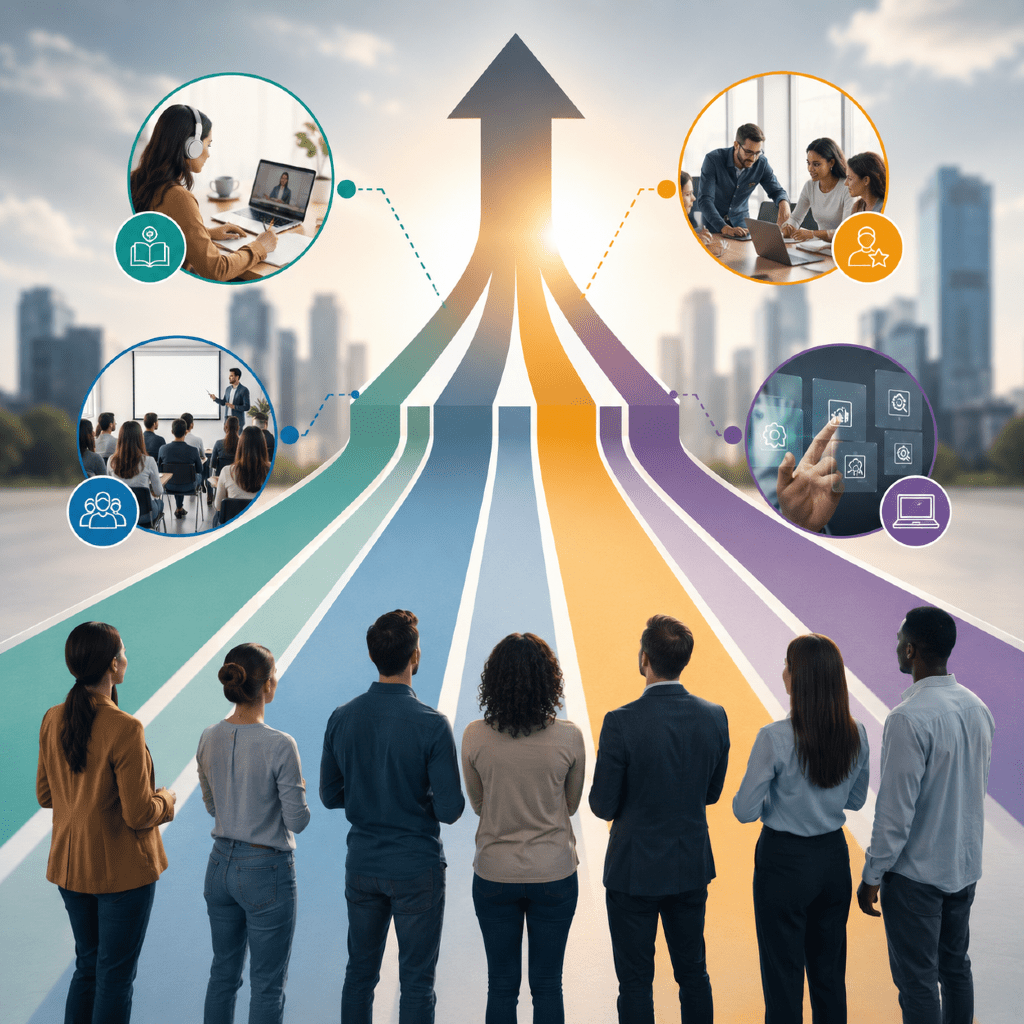
Key Takeaways
- Upskilling is essential for organizational adaptability and empowers employees for future workplace needs.
- Selecting the right strategy involves balancing organizational goals, team needs, and practical considerations.
Many organizations have increased investment in workforce upskilling initiatives, demonstrating the rising importance of continuous learning in today’s dynamic business environment. If you’re considering how to strengthen your team’s adaptability and success, understanding practical upskilling strategies can help you stay competitive and future-ready.
What Is Workforce Upskilling?
Definition and core concepts
Workforce upskilling refers to providing employees with new and advanced skills relevant to their evolving roles and the organization’s future needs. Rather than hiring externally, you cultivate your existing team’s abilities—whether technical, digital, or interpersonal—through targeted learning. Upskilling is inherently proactive, anticipating changes in your industry and equipping staff to meet them head-on. You’ll find that upskilling is often embedded within broader talent development or learning and development (L&D) programs, meant to bridge skills gaps and futureproof your workforce.
Skills relevant in 2026’s workplace
Looking ahead, the most sought-after skills extend beyond technical abilities. In 2026, employers are increasingly prioritizing data literacy, digital communication, problem-solving, adaptability, and emotional intelligence. It’s important to evaluate which of these skills align closely with your industry and roles, ensuring that your workforce is prepared not only for automation and technology shifts, but also stronger collaboration and innovation.
Why Is Upskilling Important Today?
Addressing rapid industry changes
Technology, market dynamics, and customer expectations are evolving faster than ever. As a manager or business owner, upskilling helps you respond to these rapid changes without constant turnover or retraining cycles. By reskilling employees for digital tools, workflow automation, or emerging practices, your organization becomes more resilient and responsive to disruption.
Impact on team adaptability
Upskilling fosters a culture where continuous learning is valued. When team members regularly acquire new skills, they adapt more quickly to shifting roles, project changes, or unexpected challenges. A well-upskilled workforce is better positioned to experiment with new processes and drive improvements—all while minimizing resistance to change.
What Are the Main Upskilling Strategies?
On-the-job training methods
On-the-job (OTJ) training is an accessible, hands-on approach. It includes shadowing, job rotation, stretch assignments, and real-time feedback. This method allows employees to learn new skills directly within their daily tasks, often supported by supervisors or experienced peers. OTJ training is flexible and can be customized, making it easy to address unique needs without significant disruption to workflow.
Formal courses and certifications
Formal courses, whether online or classroom-based, provide structured learning with clear objectives. Certifications in areas like project management, digital marketing, or programming can validate expertise and motivate continual growth. Many organizations offer tuition reimbursement, microlearning modules, or partnerships with educational providers to make these opportunities accessible.
Mentoring and peer learning
Mentoring leverages internal expertise by pairing less-experienced employees with knowledgeable colleagues. Peer learning can be facilitated through workshops, discussion forums, or ‘lunch and learn’ sessions, encouraging shared discovery and problem-solving. Both of these methods build stronger networks, foster mutual support, and facilitate organizational knowledge transfer across roles and seniority levels.
How Do Upskilling Programs Compare?
Time investment and scalability
On-the-job training often requires the least upfront planning, scaling organically as team needs evolve. Formal courses may require set time commitments and can interrupt regular workflow, but offer structured progression over weeks or months. Mentoring programs can be tailored to the time constraints of both mentors and mentees, scaling based on the number of available leaders or experts within your organization.
Cost considerations and resources
On-the-job training is typically more cost-effective, utilizing existing resources and minimizing external costs. Formal courses or certifications may require tuition, licensing, or platform fees, while mentoring mainly requires time investment and thoughtful pairing. The right balance depends on your budget, available in-house expertise, and the urgency of skill gaps.
Customization for different teams
Every team has distinct learning needs. On-the-job training customization is straightforward, as it can be tailored to individual roles. Formal courses can be selected by department or career track, ensuring alignment with broader goals. Mentoring works best when relationships are matched thoughtfully, taking seniority, function, and personality into account.
What Practical Benefits Can You Expect?
Boosting employee confidence
A direct result of upskilling is a noticeable boost in employee self-assurance. As team members master new skills, they’re more likely to tackle unfamiliar challenges, propose new ideas, and take ownership of outcomes. This increased confidence often leads to enhanced performance across the board.
Enhancing workplace collaboration
When your team learns together, it creates a shared language and encourages cross-functional problem-solving. New skills facilitate smoother communication, reduce errors, and nurture a culture of growth. Teams strong in collaboration tend to innovate faster, address roadblocks collectively, and support one another’s continued development.
How to Choose the Best Strategy?
Assessing organizational needs
Start with a skills audit—identify current competencies and gaps, then map these against business goals. Consider input from team members, managers, and other stakeholders to prioritize upskilling investments that offer the highest organizational return.
Balancing short and long-term goals
Short-term skill gaps can often be filled with targeted training or mentoring, while broader transformations may benefit from formal education pathways. Choose strategies that address current projects as well as anticipated future needs, ensuring you’re investing in skills that will remain relevant as the business evolves.
Can Upskilling Lead to Employee Retention?
Influence on job satisfaction
Employees who receive opportunities to learn and grow typically report higher job satisfaction. Upskilling demonstrates your commitment to their long-term success, reducing turnover and increasing overall team loyalty.
Supporting continuous career growth
By offering regular upskilling, you give team members a clear pathway for professional progression. This not only keeps your top talent engaged but also attracts driven new hires looking for organizations that invest in their people.
Common Challenges and How to Address Them
Engagement barriers
Not everyone will be immediately enthusiastic about upskilling initiatives. You may encounter resistance due to workload, lack of perceived relevance, or uncertainty about outcomes. To address this, align training content with real tasks and offer incentives to participate, such as recognition or career development opportunities.
Measuring effectiveness
It’s essential to track how upskilling translates to on-the-job impact. Set measurable objectives (e.g., productivity improvements, project delivery times, employee feedback scores) and review progress at regular intervals. This feedback loop helps you refine your approach and demonstrate the value of continued investment in your team.